 Guessroo
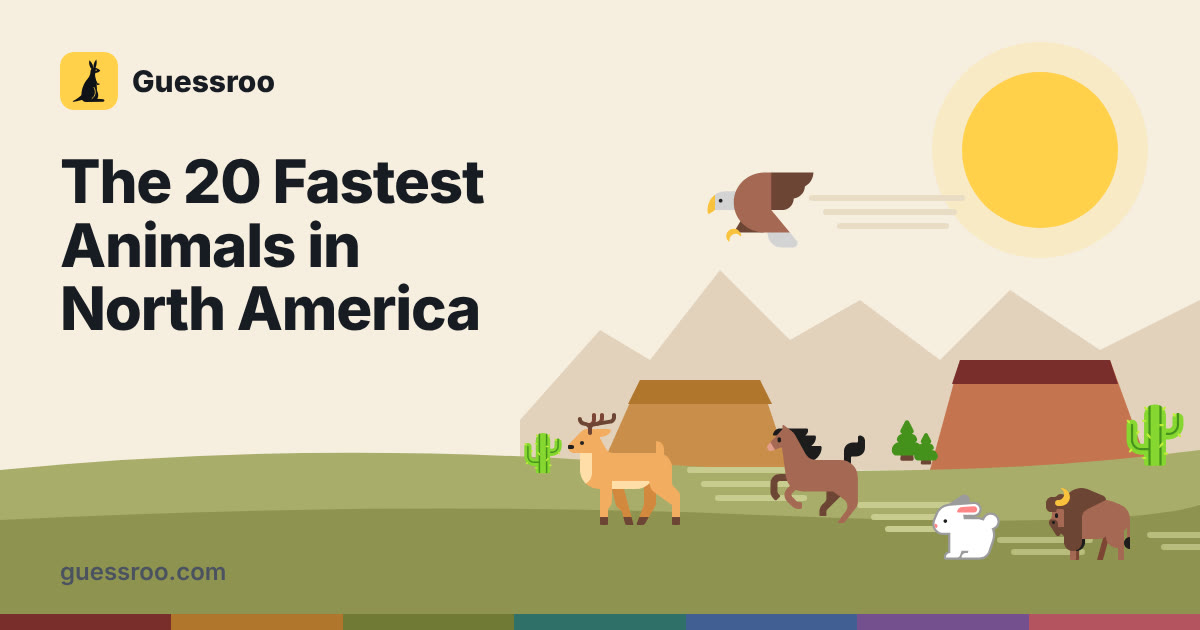
The fastest animal in North America is the peregrine falcon, which dives at about 200 mph (320 km/h); one trained falcon was clocked at 242 mph. The fastest land animal is the pronghorn, at about 55 mph (89 km/h), and the fastest in the water is the shortfin mako shark, at up to 43 mph (70 km/h). Here are all 20, ranked, with the source for each speed.
On this page
The 20 fastest animals in North America, ranked
Speeds are top speeds, usually for a few seconds, and they come from the National Park Service, state wildlife agencies, Guinness World Records and museum researchers (see Sources). Where good sources disagree, we show the range. Each linked animal has its own answer page with a guess-first quiz.
| # | Animal | Top speed (mph) | km/h | How | Where in North America |
|---|---|---|---|---|---|
| 1 | Peregrine falcon | 242 | 389 | diving | all of North America; nests on cliffs and city buildings |
| 2 | Golden eagle | 150 | 240 | diving | the West, Canada and Alaska |
| 3 | Bald eagle | 100 | 160 | diving | near water across the continent |
| 4 | Brazilian free-tailed bat | 99.5 | 160 | level flight | the southern US (Texas has the biggest colonies) and Mexico |
| 5 | Homing pigeon | 94.3 | 152 | level flight | racing lofts across the US and Canada |
| 6 | Anna's hummingbird | 60 | 97 | diving | the Pacific coast and the Southwest |
| 7 | Mallard | about 60 | about 97 | flying, when pressed | ponds and marshes everywhere |
| 8 | Pronghorn | 55 | 89 | running | the Great Plains and western grasslands |
| 9 | Mountain lion | 45 | 72 | running, short dash | the West, Florida and western Canada |
| 10 | Shortfin mako shark | 43 | 70 | swimming, in bursts | warm Atlantic and Pacific waters off North America |
| 11 | Gray fox | up to 42 | up to 68 | running | most of the US, Mexico and southern Canada |
| 12 | Black-tailed jackrabbit | 40 | 64 | running, zigzagging | western deserts and plains |
| 13 | Coyote | 40 | 64 | running, sprint | almost everywhere, including cities |
| 14 | Elk | about 40 | about 64 | running | the Rockies and the West |
| 15 | Grizzly bear | 35 to 40 | 56 to 64 | running | Alaska, western Canada, Montana, Wyoming, Idaho |
| 16 | American bison | 35 | 56 | running | Yellowstone and other parks and reserves |
| 17 | Moose | 35 | 56 | running | Canada, Alaska and the northern US |
| 18 | Gray wolf | 35 | 56 | running | Canada, Alaska and the northern Rockies and Great Lakes |
| 19 | White-tailed deer | 30 | 48 | running | most of the US and southern Canada |
| 20 | American black bear | 25 to 30 | 40 to 48 | running | forests from Alaska to Mexico |
Diving birds sit at the top because gravity does most of the work. Counting only animals that move under their own power on the level, the order changes: the free-tailed bat flies fastest, the pronghorn runs fastest, and the mako swims fastest.
Fastest in the air: the peregrine falcon
When a peregrine falcon folds its wings and drops onto a duck or pigeon, it becomes the fastest animal on Earth. Guinness World Records puts the dive, called a stoop, at about 200 mph (320 km/h) in ideal conditions. A trained falcon named Frightful, diving from nearly three miles up, was clocked at 242 mph (389 km/h), as Smithsonian's Air & Space magazine reported.
Eagles are not far behind. The Iowa Department of Natural Resources says golden eagles easily hit 150 mph in a dive, with some sources putting them near 200 mph, and bald eagles reach about 100 mph. The smallest diver is just as impressive: an Anna's hummingbird hits about 60 mph in its courtship dive, covering 385 times its own body length every second, according to National Geographic. That makes it, for its size, faster than the falcon.
Fastest in level flight: the Brazilian free-tailed bat
Without gravity's help, the record belongs to a mammal. Guinness lists the Brazilian free-tailed bat, also called the Mexican free-tailed bat, as the fastest flying mammal, with ground speeds of up to 99.5 mph (160 km/h). A study published in 2016 followed radio-tagged bats in Texas from a small airplane. Ground speed includes any help from the wind, so the bats' own airspeed may be a little lower, but the record still stands.
Millions of these bats spend the summer in Texas caves such as Bracken Cave near San Antonio and under the Congress Avenue Bridge in Austin, where crowds watch them stream out at dusk.
Fastest on land: the pronghorn
The pronghorn of the Great Plains is the fastest land animal in North America and is often called the second fastest in the world, after the cheetah. The National Park Service says it reaches a top speed of about 55 mph (89 km/h). Unlike the cheetah, it can keep going: about 55 mph for half a mile and close to 45 mph over much longer distances.
No predator alive in North America today can catch a healthy adult pronghorn. Yellowstone National Park explains why it is so fast anyway: its speed is an adaptation to outrun an extinct North American cheetah. Long legs, light bodies, big windpipes and cushioned hooves all help.
Guess first: how fast can a coyote run in a sprint?
About 40 mph (64 km/h), according to Big Bend National Park. It cruises at about 30 mph.
The surprising sprinters: bears, bison and moose
Some of North America's biggest animals are also among its quickest. Yellowstone gives grizzly bears a speed of 35 to 40 mph, and the Park Service's bear safety advice puts it plainly: bears can run as fast as a racehorse, both uphill and down. Bison, the largest land animals in North America, run up to 35 mph, according to Wind Cave National Park. Moose also reach about 35 mph, according to the Alaska Department of Fish and Game, and then swim at about 6 mph for up to two hours.
That is why parks tell visitors to keep their distance. Even the fastest humans top out at under 30 mph for a few seconds, so running from a bear, a bison or a moose does not work.
Guess first: how fast can a moose run?
About 35 mph (56 km/h), according to the Alaska Department of Fish and Game and the Minnesota DNR.
Fastest in the water: the shortfin mako
The shortfin mako is the fastest shark in the world. The Florida Museum of Natural History says it reaches burst speeds of up to 43 mph (70 km/h), and it can leap clear of the water. Makos live in warm and temperate seas around the world, including the Atlantic and Pacific off North America.
Why do speed figures for animals vary so much?
Animal speeds are hard to measure. Few wild animals run in a straight line past a radar gun, so many figures come from chasing animals with cars, timing them over a known distance, or tracking them with GPS. Results depend on the animal, the ground, the wind and whether it is a two-second burst or a long chase.
That is why sources disagree. The Texas Parks and Wildlife Department, for example, lists elk at 40 to 45 mph, while Washington's wildlife department gives 35 mph. For black bears, Park Service figures run from 25 to 30 mph, and other sources say up to 35. Where serious sources differ, this list shows the range rather than picking the biggest number.
Frequently asked questions
What is the fastest animal in North America?
The peregrine falcon. It dives at about 200 mph (320 km/h), and one trained falcon, Frightful, was clocked at 242 mph (389 km/h).
What is the fastest land animal in North America?
The pronghorn, at about 55 mph (89 km/h), according to the National Park Service. It can hold about 45 mph over long distances, which no other North American animal can.
Is the pronghorn faster than a cheetah?
Not in a sprint: a cheetah reaches about 65 to 70 mph. But a pronghorn can keep up high speed for far longer, about 55 mph for half a mile.
How fast can a grizzly bear run?
About 35 to 40 mph (56 to 64 km/h), according to Yellowstone National Park. That is faster than any human, so never run from a bear.
How fast can a bison run?
Up to 35 mph (56 km/h), according to Wind Cave National Park. Bison are also strong swimmers.
What is the fastest flying mammal?
The Brazilian free-tailed bat, tracked at ground speeds of up to 99.5 mph (160 km/h) in Texas. Guinness lists it as the fastest mammal in flight.
What is the fastest shark?
The shortfin mako, with burst speeds of up to 43 mph (70 km/h), according to the Florida Museum of Natural History.
Can a human outrun a deer or a coyote?
No. White-tailed deer run about 30 mph and coyotes up to 40 mph in a sprint. The fastest humans top out under 30 mph, and only for a few seconds.
Sources
We read these pages for the numbers above. US customary units come first, metric second; conversions are rounded.
- Guinness World Records: fastest bird (diving)
- Smithsonian Air & Space: Falling with the Falcon
- Iowa DNR: cool things you should know about golden eagles
- Guinness World Records: fastest mammal in flight
- National Geographic: Anna's hummingbird outflies falcons and fighter pilots
- Texas Parks and Wildlife: animal speeds (homing pigeon, mallard, gray fox, elk)
- National Park Service: Pronghorn, racers on the Great Plains
- Yellowstone National Park: pronghorn
- Grand Canyon National Park: mountain lion
- Florida Museum of Natural History: shortfin mako
- White Sands National Park: black-tailed jackrabbit
- Big Bend National Park: coyotes
- Washington Department of Fish and Wildlife: elk
- Yellowstone National Park: grizzly bear facts
- National Park Service: staying safe around bears
- Wind Cave National Park: bison
- Alaska Department of Fish and Game: moose
- Yellowstone National Park: wolf ecology
- Prince William Forest Park: white-tailed deer
- Marsh-Billings-Rockefeller National Historical Park: black bears
Spotted a mistake? Tell us on the feedback page or at [email protected].